
Harvesting Potatoes
* It's what you've been waiting for,
* Pick fresh and new potatoes,
* How to store your potato.
The long-awaited day for harvesting potatoes comes - you feel well-satisfied and your family and friends are proud of you. And not least because the first 'new' potatoes are much sought after and more expensive to buy.
Now you'll rest a little easier knowing you have good food in store. Because your fresh potatoes will be many times healthier than processed potatoes.
Did you know that as potatoes age their qualities change? This can affect their cooking time, and some varieties used for salads may also become suitable to roast...
How was your potato harvest? Upload your pictures & share your success or problems in growing organic potatoes with this link. Learn more with the-organic-gardener.com.
Can you harvest potatoes without spiking or slicing?
What's the secret to storing a maincrop? - You'll find the answers below...
- Harvesting new potatoes from 'earlies' or 'maincrop',
- Harvesting potatoes without spiking or slicing,
- Harvesting potatoes from maincrop for storage, and
- Late season potatoes picked from potato bags, tubs and barrels plus
- Tips on storing your potato crop.
Potatoes Are Worth Waiting For
reveals growing potato tubers
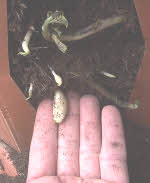
Although warm soils may help, too much warmth can cause embryo tubers to revert into leaves. Maintain adequate soil moisture and mulch well.
Harvesting Potatoes 'New'
'New' means picked fresh but not stored. They are well-grown in raised beds. 'Early' potatoes take from 60 to 90 days to crop and 'second earlies' 90 to 120 days to crop. But don't forget that 'new' potatoes can be taken from 'earlies' or 'maincrop'.A few small 'new' potatoes may be ready shortly after your potato plant flowers. They are about the size of a hen's egg - draw back the soil to see them, then replace. These 'new' potatoes are crisp fresh spuds and delicious to eat. And more potatoes may grow to replace them.
Real Potatoes Without Spiking Or Slicing
You can find them most easily by lifting up the sheeting or mulch on a raised bed. A few nice and clean potatoes will be resting on the soil surface. Take about 2 per plant when needed. Find more about growing potatoes in raised beds and potato bins.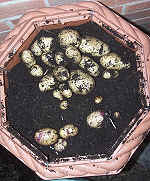
'New' Potatoes From Bags, Tubs and Barrels
With potato bags, tubs and pots carefully excavate the compost surface away to find them growing beneath. This potato barrel >> also has side doors that give you direct access to the new spuds inside.Some patio planters are made like wrap around rolls that unfasten down the side to give you access and make harvesting potatoes easy.

Don't be dissappointed if at first you don't find much. More potatoes and bigger ones should appear a little later. End of season harvesting is described below.
Harvesting Potatoes 'New' From Ridges And Hills
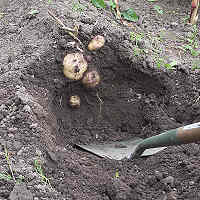
If you've grown your potatoes in ridges or hills you can carefully scrape away the soil to find those tubers worth harvesting. These will be fresh 'new' potatoes. They'll poke up through the ridge so keep them well covered to prevent them greening up. Lawn trimmings reduce Scab and make ideal mulch.- A soil scoop is useful for uncovering and lifting 'new' potatoes.
PICK MORE SPUDS...
When you continue to pick 'new' potatoes a few at a time there's a good chance that smaller 'embryo' potatoes will take up the lead and grow bigger. All those tiny spuds that you pick out end of season could grow up to proper size.
More below on harvesting potatoes end of season from bags, tubs and barrels, and Christmas potatoes.
Harvesting Maincrop Potatoes
Your maincrop potatoes should be ready in about 120 to 140 days. The potato flowering time usually indicates that they are swelling up.Whether or not you've already sampled some of your maincrop, by the end of season the bulk of your maincrop needs to be lifted from garden soil into store.
First cut down the potato haulms (stalks) and remove to your compost heap. If blighted you may choose to burn them. Blight spores were not able to survive U.K. winter cold until a new mutant strain was introduced by mistake.
|
|
|
Potato / Veg
Scrubbing Gloves
Are Really Handy
Sheet slipped
under potato
barrel to collect
last harvest &
spent compost.
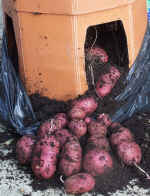
Most gardeners advise digging up potato rows from the side of the row using a flat tined fork. Short handled forks are the easiest - for the U.K. check this potato fork. You move the plant into the trench. Grasp the remaining neck of stalk to help lift the plant whole.
But I usually work differently. Starting from the end of the row I dig down and move the soil behind me taking the tubers out as I go. The exposed soil ridge looks like a quarry face. It's probably not the easiest way to do it - but I love gardening.
- You should remove all tubers from the garden soil even tiny ones, otherwise they will attract pests or grow again next year.
- Handle potatoes with care to avoid bruising them.
End Of Season Potato Harvesting From Bags, Tubs Or Potato Barrels
When harvesting potatoes from tubs I tip it upside down into a large polythene bag. Then I scrape the soil back into the empty container while picking out the tubers.Note that potato barrels and wrap arounds are more accessible.
With late season Christmas potatoes you could leave them outside in their spud tub or bag and simply cover it over. Then you won't be able to pick and sort them but the larger ones will probably be at the bottom.
Storing Potatoes
Leave your spuds outside on a riddle to dry in the sun for a few hours. I turn mine over half way through. I class the tubers into different sizes as well as clean / healthy and damaged or infected. Diseased or damaged potatoes won't keep. Look out for white furry growths and dark bruise like areas. Cut a few open to check inside.They say 'early' potatoes don't store as well as your maincrop. However, I've stored 'second early' varieties beyond Christmas in good condition. I've now found that tuber size makes little difference - but good keeping varieties are preferred.
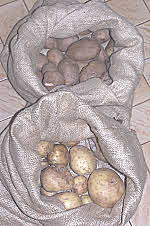
My potato harvest
stored for months
in these sacks
Then I remove the crop to hessian or burlap sacks to store in a dark cool ventilated garage. Brown paper sacks are not well-ventilated. Mine have kept well.
I also have a smaller bag that excludes the light. It has a handy velcro fastened lid and handles to lift. This spud bag serves me to have a select number in the kitchen ready for use.
- Check the spuds regularly. Any wiff of ammonia or putrid smell indicates rot. Don't ignore it. Root down until you get the offending tubers out. Any that have been contaminated with dripping ooze can be washed and used immediately.
One last thing - storing potatoes in the fridge is not recommended as it causes the starch to turn into sugars. That means if you use them for chips you get a brown color when the sugar caramalises - that might be nice.
Aids For Harvesting Potatoes
More Comfortably
| Click flag to jump to your country selection: >> |
- Potato Scrubbing Gloves - Here's a new idea! - my Mum would love these.
-
Potato sacks on these links are essential for good disease free storage.
Vegatable sacks are available here in packs of 10.
-
Potato barrels, Giant Potato Tubs, Wrap Around Patio Planters and Airpots are available from here - and you'll be harvesting potatoes on the patio.
Raised bed kits are here.
- You'll find proper sized specialised potato forks here.
-
And you may like the
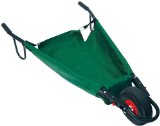
Wheel Easy to help you gather and transport the potato harvest.
And for harvesting potatoes and other crops you'll find garden mats and kneelers on this link to keep your limbs warm, dry and active.
-
Potato Scrubbing Gloves
-
Well ventilated vegetable storage is essential to keep your crop in good condition...
Vegatable storage sacks and boxes are available here...
along with potato grow bags and raised beds
-
And you may like the
Wheel Easy to help you gather and transport the potato harvest.
And for vegetable harvesting you'll also find garden mats and kneelers on this link to keep you warm, dry and active.

Example: my 2011 second early potato crop 'Juliet'
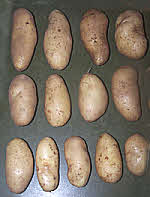
16th September 2011: Later than usual for harvesting potatoes, my second early crop of 'Juliet' is just in. Below I list the tubers by increasing size order.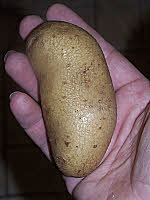 10 seed potatoes produced 100 tubers totalling about 7 kilograms (over 15 pounds).
Average tuber weight a respectable 70grams (2.5 ounces). Each potato plant produced 10 tubers and 700 grms of potato.
Grown in a raised bed (easy for harvesting potatoes) they're all high quality tubers (pictured) virtually scab free - believe me you wouldn't notice it. Note: the small sized residual makes the grand total even larger.
|
|
How was your potato harvest?
Use this link to:- Upload your pictures & share your success or failure in growing organic potatoes. Learn more with the-organic-gardener.com. |
| Tuber Size |
Number of Tubers in Size Class |
Weight of Tubers in Size Class - Grams. |
|---|---|---|
|
Large Tubers
Medium Tubers Small Tubers |
10 | 1690 |
| 10 | 1160 | |
| 10 | 760 | |
| 10 | 712 | |
| 10 | 635 | |
| 10 | 530 | |
| 20 | 900 | |
| 20 | 600 | |
|
Main Size Totals |
100 | 6987 |
|
Small Residual
Class |
Small Residual
Weight |
|
| 20 | 325 | |
| 12 | 100 | |
|
Grand Totals |
132 | 7412 |
Click here to write your article and share your news of potato growing with other gardeners.
Garden Gate
-
Follow these links to find more information on:
potato varieties, - potato growing in containers, - potato growing with raised beds, - seed potato quality, - transforming weedy ground with potatoes, - how potato plants grow, - how to harvest and store your potatoes - chitting, planting & hilling potatoes.... ... ...
My Neighbour's Garden Plots
Do Share Your Gardening Experiences - are you growing organic potatoes?
Write about your potato crop on the form below. Visitors to the-organic-gardener.com will see your photos, and read about your potato garden, a good crop or a bad crop.
So do send in your gardening experiences & tips, for example:-
- Your favourite potato varieties,
- Describe or picture any potato pests or diseases,
- Tell us about your container and raised bed potatoes, and
- Compare your crop yield with other organic gardeners.
On behalf of all the gardeners reading the-organic-gardener.com, may I take this opportunity to thank you for sharing.
What Other Visitors Have Said
Click below to read previous contributions on Growing Potatoes.
Potato Harvest - What is it? 

I grow potatoes every year, but this year I found a surprise. On the end of a couple of potato plants are these little round fruits or vegies.
I have …
Red Potatoes
I planted red potatoes and I harvested them about a week ago. I ate a few and I found them to be dry.
I would like to know what I did wrong so next …

- The Home Of The Organic Gardener - growing naturally, pure and beautiful.
^ Harvesting Potatoes from the top

Copyright © The Organic Gardener.Com 2004 - 2020.



- Organic Garden Blog
- Grow More Flowers
- Grow From Seeds
- Grow Better Lawns
- Grow Potatoes
- Organic Fertilizer
- Weed Control
- Garden Tool Shed
- Garden Power Tools
- Garden Shredders
- Grow With Compost
- Gardening Gifts
- Gardening Books
- Crop Rotation
- Organic Pest Control
- Runner Beans
- Mulch It
- Garden Watering
- Moving Shrubs
- About Organic
- About the Gardener
- Organic Links
- Contact the Gardener
- Privacy Policy
