
Certified Seed Potato
* Should you plant potatoes bought for eating?
* How are potato tubers grown specially for gardeners?
* About quality standards and certification,
Why are gardeners advised to plant Certified Seed Potato tubers and not saved tubers or shop bought potatoes? Is this advice commercially motivated?
Below I'll explain what seed potatoes are, how they are produced, and why gardeners should take notice of advice on growing potatoes.
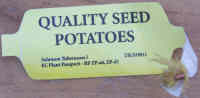
Potato plants can carry many potato diseases: bacterial, viral, and fungal; and some of these are passed on through potato tubers. Plant viral infections are persistent, so outbreaks cause all stock to be destroyed and surfaces decontaminated. You'll find out how producers keep potato stock clean further down this page...
|
|
|
|
|
|
|
Direct Gardening has the best value in everything - potato tubers better than store bought buy in bulk with your neighbours and save even more. |
|
|
|
|
Why grow from certified seed potato?
You can waste effort with store bought potatoes, while certified potato tubers costs no more.- Potatoes in food stores may come from foreign fields were infections are less well controlled (it's a bit of an unknown),
- Potato growers are in the food industry and don't guarantee their stock to be free of disease that may be passed to your future crops,
- Sprout inhibitors may be applied to tubers before transportation,
- Reputable gardening suppliers check out all the certification for you and,
- Your garden supplier will try to make available the varieties of potatoes that are most suited to your region's growing conditions,
What are Seed Potatoes? What are Minitubers?
Find out below...
Why gardeners don't save potato tubers from their own produce to grow next year's plants
Freshly dug potatoes are in a dormant state. They won't, for example, grow a follow-on crop. But as an organic gardener you will realise the importance of controlling the spread of disease. Blight is a fungus that attacks potatoes every season and may, unrecognised, have contaminated your potato tubers. These will grow blight infected plants that will start a new epidemic.A virus disease on the other hand, may not show itself in the first year. But gradually it gets stronger, your plants become weaker, and yield drops off. All the time it may be spreading and could therefore contaminate your garden again. Viral disease spreads easily and is difficult to eradicate. Burning and thorough cleaning is necessary.
The safest control is to grow clean stock and keep your country clean of the disease for everyone's sake.
Why grow from certified tubers and not from true seeds?
Like all flowering plants the potato produces seeds after flowering. These are sometimes referred to as seed balls - botanically these are berries like tomatoes but small and green. They contain the true seed or botanical seed of the potato like those you would normally sow.Because potatoes are open pollinated there is a reduced chance that seeds from plants will grow true to type. Plants raised from these true seeds bare very small potato tubers. True seeds are used in research and breeding programs where plants are usually grown together in greenhouses but isolated from other plants.
The famous Burbank potatoes started out from true seed sown in 1872 by Luther Burbank of New England. Once a good plant is found, like the 'Burbank' plant, it is then grown on from its potato tubers. This cloning over a few generations produces the larger egg-sized seed potato tubers with their selected characteristics preserved.
The original disease free nuclear stocks that are true to a variety are maintained in isolated conditions. Your horticultural potato tubers are grown in fields from the nuclear stock by selecting the strongest over several generations as described below.
- Consider small packs to try out the wider variety and flavour than shop bought,
- You'll find even better value when you buy and grow more to feed the family,
- Or try potato grow bags with selected potato varieties included,
- Click here to select your potato with help from the-organic-gardener.com
Commercial Seed Potato Growing
Disinfectants may be applied to the material and testing is done over several stages to check for any disease. Several generations may be grown, going from tissue culture to the relative isolation of greenhouse containers. The strongest and best examples of the cleared stock are grown on and planted out in fields. Further checks ensure its health and reliability going forward.
In Canada the presence of Bacterial Ring Rot for example is enough to close the whole of a producers operation. In Canada and in The States industry standards help to give gardeners potato plants free of the diseases you may not notice until later.
Moreover, gardening suppliers in the U.K. such as Thompson & Morgan have decided to restrict the source of their stock to U.K. seed potato producers because of infections in European stocks. There are also small differences in European - UK classification rules.
Check out top quality seed potato tubers to grow in your country...
The top classes of seed potato starting closest to the pure nuclear stock go from pre-basic, basic, elite I, II and III. Certified Seed potato passes all the tests but comes at the bottom. Look out for these labels in the U.K. and E.U.
| Category: | National Class: | Community Grade: | Label: |
|---|---|---|---|
| Basic | A | EC3 | White |
| Certified | CC | None | Blue |
- Note that 'Minitubers' come near the beginning of the process and are therefore more pure than 'Certified' i.e. they have been less exposed to diseases.
So the Minitubers now being made available by garden suppliers like Thompson & Morgan are higher than Elite class.
Check out quality potatoes for planting in your country - on this link
Cut Potato Tubers - Potato Pieces
Bulk storage and transport of potato tubers is very costly. This is one reason that some suppliers offer potato pieces. However, potato pieces are not the full deal as they produce a reduced crop of potatoes. They may produce small sized tubers.On this link you can check out quality potato eyes & potato tubers for planting in your country.
Using True Seed In Asia
There is some interest in developing the use of true potato seed for growing in countries like Pakistan and Africa. The cost of transporting and storing potato tubers is further exacerbated in warm climates.China has used true seed to make seed potatoes for planting and now has a thriving potato industry.
However, the use of true seed is likely to be restricted to breeding programs that will produce varieties that are better adapted to the local climate and therefore permit local production of seed potato (i.e. tubers from which to grow your potato plants).
Grow potatoes at home from potato tubers:-
Check out quality suppliers in your country - on this link
The potato plant originated in the Andes of South America. Therefore it enjoys the cool climate in Canada mainly the northern United States and northern Europe.
In Idaho, and Washington in the United States, in Canada, and in Scotland in the U.K. the harsher climate helps potato growers maintain disease free stock - Maine, the Ukraine and China are among other important potato growing areas.
Get Growing at Home and
You Can Enjoy Real Fresh Potatoes.
You Can Enjoy Real Fresh Potatoes.
Quality Horticultural Potatoes In Your Country.
|
Garden Gate
-
Follow these links to find more information on:
potato varieties, - potato growing in containers, - potato growing with raised beds, - seed potato quality, - transforming weedy ground with potatoes, - how potato plants grow, - how to harvest and store your potatoes - chitting, planting & hilling potatoes.... ... ...
ALSO on the-organic-gardener.com
-
My Neighbour's Garden Plots
Smiddy from Expert Village explains that cut potato pieces need to heal before planting. This advice is for maincrop only.Potato reference page.
Do you run a gardening website - with information to interest my visitors? To set up exchange links from/to suitable pages - click here.

Custom Search
- The Home Of The Organic Gardener - growing naturally, pure and beautiful.
^ Top of the Certified Potato Plot

Copyright © The Organic Gardener.Com 2004 - 2020.

[?] Subscribe To This Site


- Organic Garden Blog
- Grow More Flowers
- Grow From Seeds
- Grow Better Lawns
- Grow Potatoes
- Organic Fertilizer
- Weed Control
- Garden Tool Shed
- Garden Power Tools
- Garden Shredders
- Grow With Compost
- Gardening Gifts
- Gardening Books
- Crop Rotation
- Organic Pest Control
- Runner Beans
- Mulch It
- Garden Watering
- Moving Shrubs
- About Organic
- About the Gardener
- Organic Links
- Contact the Gardener
- Privacy Policy