
The Mysterious Underworld Of
Potato Plants
* About how your potato plant grows,
* Where potatoes come from & potatoes in season,
* Something on potato pests...
Potato plants are amazing. A staple food crop home-grown by gardeners and eaten in many different ways. Potatoes are grown in America from Calilfornia to Vermont, as well as in Scotland, Ireland, England and the Russian Federation. But they originate from the Andes of Peru and Bolivia where many different kinds are grown by villagers - there's more below on how potato plants grow...
The Spanish Conquistadors brought them back to Europe, but Sir Walter Raleigh is accredited with introducing them to England around 1586. Quoting 1Thomas Hariot, (Raleigh's second in command left in charge of Virginian settlers who were rescued by Francis Drake) the potato was described as:
"a kind of roots of round forme, some of the bignes of walnuts, some far greater, which are found in moist & marish grounds growing many together one by another in ropes, or as thogh they were fastnened with a string".
These first potatoes were brought back among plant specimens and planted in Raleigh's estate in Ireland. But it took sometime for them to become popular.
Nowadays potato plants are one of the world's major crops ranking alongside cereals. Through plant breeding, the tubers of modern potato plants have become substantially sized and range from rounds to oblongs, of varied skin textures, with nutritious flesh that's easy to cook and adapt to many tastes and dishes.
More on potato varieties.
|
|
|
|
|
The Growing Potato Plant
It all starts with the potato tuber that gardeners buy as seed potato. Take a look at one and you'll see that (unlike a root) the surface contains dormant buds or 'potato eyes'. These are more or less concentrated at one end, the 'rose end', and spaced in a spiral arrangement around the tuber.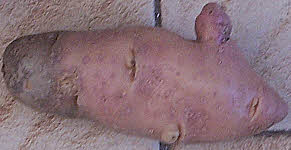
The lovely Pink Fur Apple is
a knobberly stem tuber.
The potato tuber is actually an underground stem - the buds you see, shoot out into stems and leaves. Tubers of this type are collectively known as stem tubers. They are produced from underground side stems as storage organs for your potato plant.
Seed Potato > Chitting / Sprouting > Potato Plant > Stolons > New Potatoes
When the temperature rises the potato tuber's buds begin to grow out. Gardeners call this chitting. Chitting sets up early and second early potatoes to take maximum advantage of lengthening days. And it sends the signal to produce embryo potato tubers.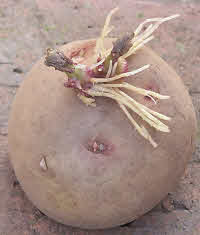
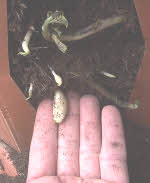
The Potato right >> 'Vivaldi' couldn't wait to send out branches. These will swell up into potatoes.
First, the shoots or potato eyes, swell up into fat knob like structures bearing leaf shoots. When one or more shoots have extended into short thick stems the tuber is planted - More on potato chitting...
Small branches grow out from the stem. They develop hooked ends and swell up into embryo potatoes. However, if potato plants are kept too warm the shoots on these embryo potatoes grow out, reverting the side branch into a leafy shoot.
Container growing should aim to preserve these young stolons in good condition. Then as you pick your first spuds more tiny potatoes will be available to enlarge into good sized spuds to harvest.
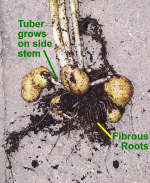
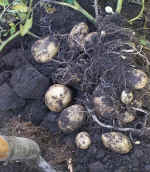
The picture (top right of page) shows a harvested potato plant 'Home Guard'. You can see the thick blanched stems that supported the green leaves above ground. Side stems (stolons) coming off these carry the potato tubers that you pick to eat. You can also see fibrous roots that absorb food and water for the plant and potatoes to grow.
Growing Conditions
Preferring a cool climate, potato plants grow best in a nutrient rich, moisture retentive and well-drained soil. They also prefer more acid soils with an ideal ph of 5.5. The potato plants begin to grow in garden soil at around 8 - 10oC - 48oF.The plants should be covered over with fleece before any frost. Frost damages the shoots setting the plants back, but they will recover. Don't forget that you can plant early potatoes in containers temporarily located in a greenhouse or conservatory before going outside. You'll find several methods to grow potatoes here...
Organic Potato
Growing Links
Growing Links
>
>
>
>
>
>
>
the-organic-gardener.com
>
Varieties
>
Grow bags, tubs & barrels
>
No-dig raised beds
>
Chitting, planting & earthing up
>
Certified seed
>
Potato plants & how they grow
>
Harvesting
There's more onthe-organic-gardener.com
>
Potato tubers become green if exposed to light. This green colour is chlorophyll but it causes an increase in a poisonous compound called Solanin that can make you feel ill. Therefore it's important to keep tubers covered by earthing up around potato plants and mulching.
Potato Season
Potatoes are recognised as First Early, Second Early and Maincrop depending on the time the potato plants take to crop. All potatoes can be planted about 2 weeks before the last frost, maincrop may be left until April or early May.The main limitation is in giving enough time to crop before temperature and day length are prohibitive. And to get all-year-around potatoes you'll want to stagger different season varieties.
So for the earliest summer potato crop 'Earlies' should be put out for chitting from mid January, as this may take 6 weeks before they are ready to plant.
Second Early potatoes crop in 90 to 120 days and they can give you a larger crop of new potatoes to eat fresh or store.
When planted early 'First' and 'Second Early' potatoes can miss out on late potato blight disease. If you especially like one these varieties you can plant them later too.
Maincrop potatoes are ready in 120 - 140 days. Although they take longer to mature they are worth waiting for. You need a bit more room to grow them in the garden.
'Maincrop' can produce a higher yield of larger potatoes some suitable for baking and most suitable for storing into the new year.
|
|
|
|
Discover more great potato varieties for you to grow at home.
The growing potato plant eventually produces flowers (although some varieities may not) and the potato tubers enlarge. New potatoes can be picked a couple at a time just a few weeks after flowering commences. When the foliage begins to yellow and die down the crop can be harvested whole. Check important details on disease control, harvesting potatoes and storing.
Potatoes From The Garden Make Real Healthy Eating
It was once told that potatoes are fattening. Not so! Sometimes people refer to a 'couch potato' to describe people who laze around watching TV. - Nothing could be further from the truth.- Your potato contains no fat and no cholesterol for you to worry about,
- Provides nearly half of your the daily vitamin C (rice & pasta have none),
- Nearly twice the amount of potassium as a banana,
- Plus fiber and vitamin B1 and B6.
And of course no one can call you a 'couch potato' when you get out into the garden and grow them.
Potato Plant Relationships
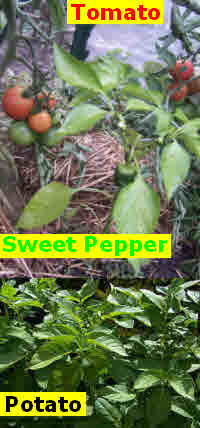 Potato plants and tomato plants are closely related. They both belong to the same plant family Solanaceae along with Aubergine (Egg Plant), Capsicum (Sweet Peppers, Chili Peppers, and Paprika), Nicotiana (Tobacco), Petunia, Belladonna (Deadly Nightshade) and others.
You'll notice that potato plant leaves are somewhat similar to their cousin's tomato leaves. And you're potato plant will probably grow berries that look like small green tomatoes (these are poisonous).
So it's best not to grow potatoes next to one of it's relatives or vice versa, as this increases the chances of passing on disease such as the fungal and viral infections that have adapted to infect this plant family.
Plants of the potato family contain alkaloids which are poisonsous. Keep potatoes in the dark to prevent them going green - pure and simple.
But it's best to discard green potatoes. With a large spud and just a bit of green I'm personally tempted to remove any green and a bit more before cooking the potato. I think the main problem is that it can spoil the taste, but some people and children may be more sensitive to the toxin.
Potato Plant Diseases and Pests
Undoubtedly the poisons in leaves help the plant resist attacks from pests such as insects.Blight however is an important fungal infection. Early season blight caused by Alternaria is not so bad, with black spots surrounded by yellow patches that can turn the leaves brown.
However, the later season blight can be devasting and more so as it causes infected potato tubers in store to rot. Water soaked areas looking like a faintly washed out green appear on the infected leaves along with yellow and black patches and you may see the fungal fur.
Sometimes crops can be destroyed overnight. Potato blight was the cause of the Irish potato famine of 1845 - 1852 when it also affected Scotland and Europe.
Note that fungal spores wash off the leaves into the soil where they infect the potato tubers. Affected potato tubers look bruised and will rot to a smelly mush - see my page on Harvesting Potatoes.
Stop The Rot
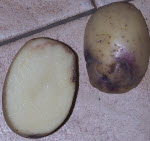 Potato blight spreads rapidly when leaves are wet, the humidity is over 75%, temperature above 10oC. It is important for organic gardeners to play their part in stopping the disease spreading.
This can be done by growing resistant varieties, keeping an eye on the weather and cutting away affected folliage quickly. Certainly burn all affected material and wash containers and bags. Unfortunately I can't recommend the copper based Bordeaux Mixture even though it is permitted. It appears to have troublesome effects on human health. It's lime content is not so good for potatoes either.
Potato plant pests of note include: Eelworm and the famed Colorado Beetle. These can feed equally well on Aubergines (Egg Plant). Slugs can also be damaging.
Always Grow Potato Plants By Rotation
Remember to grow potato plants in different soil beds year on year and put them on the longest rotation that you can manage.Also keep them well apart from tomatoes, egg plant and the like.
- Growing potato plants in bags and containers helps to isolate them from soil pests and gives the garden soil longer to rest after a previous crop.
- I usually leave several years between substantial maincrops and make do with smaller potato beds and potato bins in the meantime.
|
|
Direct Gardening has the best value in everything
- seed potatoes better than shop bought
buy in bulk with your neighbours and save even more.
|
Garden Gate
-
Follow these links to find more information on:
potato varieties, - potato growing in containers, - potato growing with raised beds, - seed potato quality, - transforming weedy ground with potatoes, - how potato plants grow, - how to harvest and store your potatoes - chitting, planting & hilling potatoes.... ... ...
ALSO on the-organic-gardener.com
-
My Neighbour's Garden Plots
See this link to a report by Thomas Harriot on Sir Walter Raleigh's American Colonies.Do you run a gardening website - with information to interest my visitors? To set up exchange links from/to suitable pages - click here.

Custom Search
- The Home Of The Organic Gardener - growing naturally, pure and beautiful.
^ View From The Top Of The Potato Plant

Copyright © The Organic Gardener.Com 2004 - 2020.

[?] Subscribe To This Site


- Organic Garden Blog
- Grow More Flowers
- Grow From Seeds
- Grow Better Lawns
- Grow Potatoes
- Organic Fertilizer
- Weed Control
- Garden Tool Shed
- Garden Power Tools
- Garden Shredders
- Grow With Compost
- Gardening Gifts
- Gardening Books
- Crop Rotation
- Organic Pest Control
- Runner Beans
- Mulch It
- Garden Watering
- Moving Shrubs
- About Organic
- About the Gardener
- Organic Links
- Contact the Gardener
- Privacy Policy