
Growing Potatoes
- Here you'll find a method of growing potatoes that is right for you and your garden.
- You'll discover how to extend the potato growing season & be more productive.
- You'll learn how to grow potatoes in small spaces too.
So let me show you how to grow a great crop of potatoes - there are several methods - so choose one that is suited to you...
- How to use a potato crop to break in new ground and remove weedy patches. This one I love... it's a tradition worth passing on,
- How to produce a versatile and dependable bulk crop from either your garden earth or from containers,
- How to get a quick early crop and, how to extend the season to get fresh spuds as late as Christmas time,
- How to harvest potatoes and store them over winter... ... see links below.
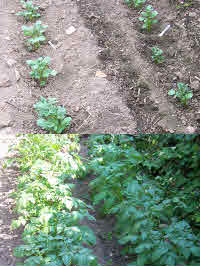

Grow Organic
Potatoes Today
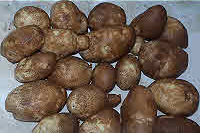

Feed The Family
Tomorrow

growing potatoes
on this link.
...And you'll have
lots of fun & fresh air
in your garden too.
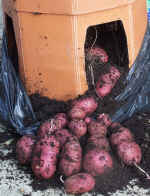
'Red Duke of York'
gives me early, clean, disease-free spuds in a barrel
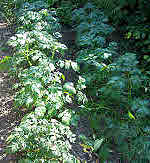
Traditional potato ridges leave my ground in great condition for the next crop.
How Do You Like Your Spuds?
There's a huge variety of seed potatoes available for home growers
so
now you can choose...
Your cooking style - mashed, boiled, baked,
Your select flavour,
Your growing methods - good earth or compact containers, plus...
You get the fresh and organic quality of home-grown spuds. There's a link further below to help you select your favourite potato varieties but look just below first to find the most suitable method of growing potatoes around your home...
Look below to find a suitable growing system for your garden or patio, followed by choosing a site, preparing the soil, & potato crop rotation for organic gardeners.
Choose Your Way of Growing Potatoes
to Suit Your Garden and Your Needs
Let's say > > >
-
You want the earliest 'new' potatoes fresh for summer salads,
You only have a patio, paved yard, or balcony to grow in,
You want to pick fresh potatoes for Christmas roast dinner,
> >
Try growing in potato tubs and barrels as explained here.
-
You'd like a potato crop but...
digging, hilling, and lifting potatoes is too much effort or,
Your garden soil is chalky or limey, heavy or waterlogged,
You want to grow clean unblemished prize winning potato tubers,
> >
Click here to grow perfect potatoes under sheets and in raised beds.
*One time only*
To find the best page
links for your
garden's region
V V please select below V V
-
You have new ground to break in and weeds to clear,
> >
You can easily transform your weedy patch into a potato crop.
-
You love potatoes all year around,
You want a substantial potato crop to put in store.
Why not combine growing 'earlies', 'second earlies', 'maincrop', and late season potatoes.
You want large potatoes specially for baking.
> > Discover how to get more from traditional ridge and furrow.
-
You like attractive good tasting spuds suitable for boiling, mashing, roasting, baking... ...
> > Check out the vast range of potato varieties and cultivars that are available for you to grow at home.
How to Grow Potatoes at Home
Site and Soil for Growing Potatoes in Garden Soil
Choose a site that's open to plenty of light. Poor light will certainly reduce yields - and that also applies to growing in containers. You might use a dark corner to site your compost bin, but it won't do for growing potatoes.
Potatoes grow best in a nutrient rich, moisture retentive and well-drained soil. They also prefer more acid soils with an ideal ph of 5.5. A
sandy loam is supposed to be the best (but it's really just one example of what grows) and all soils can be improved.
I'd be happy to grow my spuds in nutrient enriched organic soils, most alluvial soils, silt, or light clay loams. Gardeners should add plenty of bulk organic matter to open up more difficult clay soils. If you have a cold wet or dry lime/chalky soil then try growing potatoes in raised beds filled with good moisture retentive compost.
Actually my garden contains sandy-clay loam and potatoes grow well, but not too close to the hedge. The hedge roots dry the soil and the hedge itself casts shade.
Planting Potato Tubers
You'll find more here about preparing potatoes for planting by chitting potato tubers, as well as about growing potatoes in traditional rows, and earthing up ridges or hilling.
Transform A Weedy Plot
By Growing Potatoes.
Potatoes have been traditionally used to break in new ground. A potato crop competes strongly with weeds, for light, water and nutrients. Previously added manure or garden compost may explain part of the improved soil condition. However, long experience of growing potatoes suggests to me that the potato plants themselves are responsible for improving the land into one of the most perfect crumbly soil textures that a garden can have.
Growing potatoes provides many opportunities to tackle weeds and improve garden soil all at the same time. So when you are doing a weeding job around potatoes you also have the reward of a good crop to look foward to. The potato plants help you too, and your earth will be left in great condition for a follow on crop.
-
You clear weeds before digging in manure,
-
Pick out recurring weeds again when planting,
-
Your potato crop competes strongly for nutrients and water and casts heavy shade on any struggling weeds,
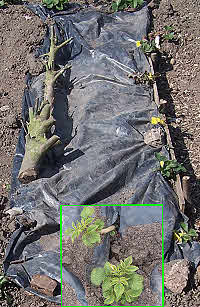

Controlling weeds & growing potatoes under a sheet.
-
You get another chance to weed as you go about hilling up or ridging,
-
Your own efforts are strongly supported by the weed smothering and competition of the potato plants by themselves,
-
Finally with your reward in sight you can weed again while harvesting potatoes,
ALTERNATIVELY: >>>
You can have weed free potatoes by growing under sheeting...
Did you know that potatoes readily form under a light excluding sheet?
All you have to do is:
-
cut the weeds to the ground,
-
plant your potato tubers - they don't have to be deep,
-
cover with a light excluding porous sheet,
-
make holes in the sheet when potato shoots appear to let them grow through,
You'll get direct access - no fork or spade, no spiking or slicing - to nice clean potatoes growing under the sheet.
But of course you'll get a better crop if the ground has been previously manured. And I suggest growing a slug resistant variety with this method.
Click here to learn
more on potato growing in difficult places.
Crop Rotation When Growing Potatoes
Crop rotation means growing a particular crop in different soil beds year on year. Therefore 4 different soil beds are needed for a 4 year rotation. Crop rotation is very important for potatoes because it helps prevent the build-up of soil disease and persistent pests such as eel worm.
Potatoes should have the longest possible rotation and every 4th year is an absolute minimum interval before you grow them in the same soil again. Try 8 years if you can (an annual crop would require 8 adequate size soil beds). - But if you have a small garden you may be able to use raised beds or potato bins to help you get a potato harvest in between time.
Find raised bed kits here.
How long does it take to grow potatoes to harvest?
Potato varieties are grouped by the length of their growing season. All types can be planted early, but the first crop comes from 'First Earlies'. 'First early' are ready in as little as 60 days. Maincrop are ready in 120 - 140 days.
Extend Your Potato Growing Season
If you've still got space for growing potatoes after last date for 'Maincrop' planting, then change back to 'Second Earlies' and finish the summer by planting 'Earlies' again for a Christmas harvest - see next link for details.
Moreover, if you can't wait for your potatoes to grow bigger, then sometime after flowering, simply scrape away some soil and pick them 'new' and as you like. Otherwise you should wait until the leaves die down to harvest the maincrop whole.
Your nationality/region
For the most useful
page links please select...
My recommended seed potato suppliers will provide the right potatoes for your country - so you can take your choice. First, if it is not displayed, >> please set your nationality / region in the box right >>>
The next link will help you to time your potato growing season in the UK.
You may be interested to know that the Home of the Organic Gardener sends out a free ezine about organic gardening with gardening offers, money-off vouchers, seasonal tips on organic gardening, and the latest gardening information. You can subscribe to it below.
Garden Gate
-
These links have information on:
potato varieties,
-
potato growing in containers,
-
potato growing with raised beds,
-
about seed potato quality,
-
how potato plants grow,
-
transforming weedy ground with potatoes,
-
chitting and planting potatoes,
-
how to harvest and store your potatoes... ... ...
ALSO on the-organic-gardener.com
-
Organic Lawns -
Organic Fertilizer -
Growing Potatoes -
Growing Flowers -
Grow Seeds -
Tool Shed -
Power Tools -
Garden Shredders -
Garden Compost -
Garden Gifts -
Garden Books -
Runner Beans -
Garden Mulch -
Watering -
Moving Shrubs -
Organic Weed Control -
Organic Garden Pest Control -
Gardening Diary/Blog -
About Organic -
My Neighbour's Garden Plots
You'll find more about
backyard gardening with raised beds on this link.
Discover how
Organic Farming is Growing around the world.
Do you run a gardening website
- with information to interest my visitors?
To set up exchange links from/to
suitable pages - click here.
 Custom Search
-
The Home Of The Organic Gardener -
growing naturally, pure and beautiful.
^
Potato growing from the top

By Michael E. J. Scott.
Copyright © The Organic Gardener.Com 2004 - 2020.

to Suit Your Garden and Your Needs
You only have a patio, paved yard, or balcony to grow in,
You want to pick fresh potatoes for Christmas roast dinner,
> > Try growing in potato tubs and barrels as explained here.
Your garden soil is chalky or limey, heavy or waterlogged,
You want to grow clean unblemished prize winning potato tubers,
> > Click here to grow perfect potatoes under sheets and in raised beds.
*One time only*
To find the best page
links for your
garden's region
> > You can easily transform your weedy patch into a potato crop.
You want a substantial potato crop to put in store.
Why not combine growing 'earlies', 'second earlies', 'maincrop', and late season potatoes.
You want large potatoes specially for baking.
> > Discover how to get more from traditional ridge and furrow.
> > Check out the vast range of potato varieties and cultivars that are available for you to grow at home.
By Growing Potatoes.

Controlling weeds & growing potatoes under a sheet.
ALTERNATIVELY: >>>
Your nationality/region
page links please select...
For the most useful
page links please select...
My recommended seed potato suppliers will provide the right potatoes for your country - so you can take your choice. First, if it is not displayed, >> please set your nationality / region in the box right >>>
-
These links have information on:
potato varieties, - potato growing in containers, - potato growing with raised beds, - about seed potato quality, - how potato plants grow, - transforming weedy ground with potatoes, - chitting and planting potatoes, - how to harvest and store your potatoes... ... ...
Organic Lawns -
Organic Fertilizer -
Growing Potatoes -
Growing Flowers -
Grow Seeds -
Tool Shed -
Power Tools -
Garden Shredders -
Garden Compost -
Garden Gifts -
Garden Books -
Runner Beans -
Garden Mulch -
Watering -
Moving Shrubs -
Organic Weed Control -
Organic Garden Pest Control -
Gardening Diary/Blog -
About Organic -
Custom Search
Copyright © The Organic Gardener.Com 2004 - 2020.
[?] Subscribe To This Site


- Organic Garden Blog
- Grow More Flowers
- Grow From Seeds
- Grow Better Lawns
- Grow Potatoes
- Organic Fertilizer
- Weed Control
- Garden Tool Shed
- Garden Power Tools
- Garden Shredders
- Grow With Compost
- Gardening Gifts
- Gardening Books
- Crop Rotation
- Organic Pest Control
- Runner Beans
- Mulch It
- Garden Watering
- Moving Shrubs
- About Organic
- About the Gardener
- Organic Links
- Contact the Gardener
- Privacy Policy