
Tips For Starting Seeds At Home
* Succeed with seeds and grow more,
* An easy start for growing your seeds,
* Make the most of your seed.
If ever there's a need for 'green fingers' it must be for starting seeds. But growing your own from seeds is the biggest cost saving in gardening and the organic
More seedling trays
to pack every space
with pretty flowers
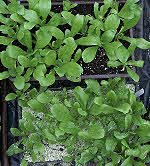
know-how needed for success is detailed below.
This page outlines the proper use of trays, modules, and propagators and other aids to help you get better results when raising plants from seeds.
to pack every space
with pretty flowers
Methods for sowing seed directly outdoors are described on my vegetable seed and later on lawn seed.
Organic Gardening Advantages To Starting Seeds In Propagators, Trays, Pots And Modules.
- Your plants are protected from pests, such as birds and slugs,
- You're seeds are protected from the vagaries in outdoor weather conditions - chill winds and snap frosts,
- Well-prepared seed compost and well-designed modules give you consistent results and strong plants,
- Starting seeds in the warmth, undercover, gives you an earlier, longer growing season,
- You'll grow a wider variety of plants by controlling warmth, moisture and light.
Grow for Containers, Hanging Baskets, and Flower Bedding,
Seed starting methods with propagators and modules are especially useful when transplanting into containers and hanging-baskets. And with more expensive F1 hybrid seed for your ornamentals, you really won't want to waste them on less certain methods in the open garden.|
More About Growing Seeds |
|
>
Flower Seeds
> Vegetable Seeds > Seed Mats/Tapes > Introducton to Seeds V
See my Propagators
below... |
The Secret of Success When Starting Seeds
Suitable compost is important for success.
-
Compost with air-filled spaces to carry sufficient oxygen to growing roots,
- This is also warm compost,
-
Fine grade seed compost - (so-called 'multi-purpose' may contain hard lumps),
- Stiff lumpy soils won't be suitable,
-
Free draining but moisture retentive seed starting compost should be used,
- Leave a tray of compost standing in water to saturate, then remove it to drain,
-
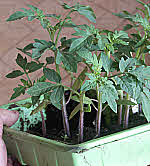
Modern gardeners resort to sterilized seed compost,Growing Large
or Small?To Grow in Quantity >>
or
For High Value,
or Long-Stay Plants <<
&
Click Here For
Early Plants <<- Later I will describe my home-made organic mix...,
Seed Sowing Depth, Preparation And
Whether To Cover Seed
Use Seed Trays to Raise Large Numbers of Plants from Small Seeds and Prick Out into Pots.
- You need to fill your seed tray with compost,
-
Gently tap down, firm the compost and make it level,
- The tiniest seeds are merely pressed onto a level surface of compost and not covered. Use a dry wood block to gently firm. Trays so prepared may be sealed in a polythene bag but remain exposed to light,
- Cover larger seeds to the required depth. This is usually 3 times the seed diameter,
- Gently firm your compost to help ensure that your seeds are in intimate contact. You can expect greater returns. Making compost more consistent also helps your seeds to germinate at about the same time,
- Nowadays gardeners frequently cover seeds with a single layer of perlite, vermiculite or fine grit. These minerals help conserve moisture and increase humidity. They also protect the seeded layer if you use a watering-can spray,
- You might finish with one sprinkle from a fine rose watering-can or misting. But note that heavy watering can displace small seeds leaving them exposed, swamped or crowded.
|
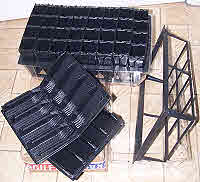
Root Trainer modules open like a book & air prune roots
|
|
For smaller numbers of high value plants - fruit, vegetable, and expensive F1 hybrid flowers - modules are better used for raising your plants.
Starting Seeds In Modules And Rootrainers
Modules avoid the extensive root disturbance that accompanies pricking out from trays. Seeds that are big enough to handle individually - anything from the size of tomato or sweet pepper seed and larger - are well-grown individually in modules. These seeds give high germination rates in properly prepared compost and I sow one per module.Although cucumbers, melons - being less reliable may be sown 2 per module - nevertheless, I sow expensive F1 hybrid seed into individual modules.

When to Use Larger Modules
Bigger modules are used for long-stay plants such as those sown in the fall to overwinter. A larger compost volume feeds the plants and better protects the roots over this extended period.For example: onion seedlings left to overwinter will be at risk in small shallow modules. Larger plants such as melons, cucumbers, and marrow, should be given every opportunity to grow a strong root system unchecked.
|
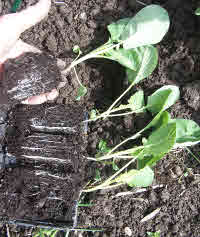
Modules like these, reduce root disturbance & plant stress. Transplanting these cauliflowers is easy to do. |
|
The Advantage Of Rootrainers
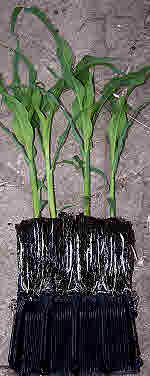
You can grow a well-branched fine root system with help from Rootrainers™ (Root Trainers). Their ridged design air-prunes roots and stimulates branching. This reduces the length of old root and prevents them circling the outside as is typical in ordinary pots.Root trainer modules are deeper than wide, helping to ensure transplants are deeply rooted. While ordinary pots require tapping out, these modules open like a book. You'll be able to observe fine roots running up as well as down. You'll know when your plants are ready to go out. And then it's much easier for you to remove plant plugs without disturbance.
Note: whatever modules or pots you use, always soak plugs before transplanting.
|
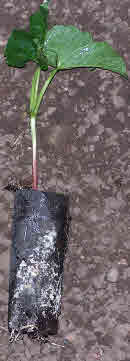
planted out direct & roots grow out. |
|
Deep Fyba Grow Tubes
These long biodegradable tubes are ideal for starting seeds of beans and planting out direct in the ground. The roots grow out through the pots which themselves break down in the soil. One word of caution, you should plant the rim of the pot below the soil surface to ensure it doesn't wick out water. Deep Pots are here. You'll also find pots made from recycled, biodegradable, organic materials such as Jiffy pots, paper pots, coir pots or cow pots more here ... ...
Starting Seeds Early,
A Long Season, All Season,
Aids to Growing Success
All too frequently, even the basic conditions for starting seeds are missing. With a little help you can:-
- Give your seeds the minimum temperature in-spite of the cold. Early plants have longer to develop and some flowers can be brought to flower in one year instead of two. Many plants can be made to bloom or crop for longer.
- Maintain the right amount of water for germination and then for growth. When soil dries, growing roots are harmed. Too damp and plants may rot.
- Maintain sufficient ventilation but protect plants from drafts.
- Don't rely on the poor window light at the short ends of the season. Light is essential to maintain straight-up plants and avoid week elongated stems.
Fortunately home-grow systems are now available to help gardeners maintain steady moisture, warmth and light - all of which are needed for plants to grow well. They range from propagators with reservoirs and built-in capillary matting, to heated propagators.
Propagators are here...
Heat mats save you heating the whole place.
Most importantly, heat mats provide an even controlled temperature to save shocking plants during cold snaps. And this helps control disease by promoting healthy active root growth. You can advance sowing dates by raising the minimum soil temperature.After Starting Seeds - More Light Is Essential
Overcast days simply don't produce enough window light for seedlings. Although it's warmer indoors your plants become drawn with long thin stems that are yellowed and rather weak. But here's an alternative to heating a greenhouse.Take advantage of any warm room by adding an indoor horticultural lighting system.
- You can keep plants clear of cold windows,
- Lights let you grow more plants of high quality,
- Lighting adds an elegant and attractive feature inside your room,
- You can transform the look of any dark corner with attractive plants. Also...
And all this to help you make a home and garden full of fresh tastey food plants and beautiful fragrant flowers. Good luck with starting seeds.
What You Need For Starting Seeds
Click flag to jump to your country selection: >>
- Larger Deeper Rooting 3" Seed starting modules on this link are good to grow high-value or long-stay plants from seed.
-
Choose a good fine seed compost like the
germinating mix on this link.
- Rootrainers™ (Root Trainers) - for starting seeds or cuttings, to make fine branching roots, and plugs that transplant easily without disturbance.
-

Gentle warmth makes good growth without heating the whole space. Heat mats are available on all the above links or alternatively on this link.
-
These
grow lights brighten a warm room to make sturdy plants and enhance your decor. You can use them to breath some oxygen into your room.
- Here's a well-designed propagator with pop-up cells. You can give up to 49 young plants a great start from seed. Versatile multi-purpose features and built-in self-watering means no fuss, available on this link.

|
|
from Rootrainers |
- Transplant pots with tray includes a water reservoir and capillary matting to help ensure that your seedlings don't wilt. For longer stay plants and no worries when you go away.
-
Rootrainers™ (Root Trainers) - for starting seeds or cuttings, to make fine branching roots, and plugs that transplant easily without disturbance.
Fyba Grow Tubes are here for growing beans. -
Here's a plain simple Self-Watering Propagator with small modules
and...
here's a self-watering propagator with 7 seperate trays. -
To get heat demanding flowers and fruit off to an earlier start use heated propagators like
those on this link.
You'll also find seperate heat mats and trays available on this link.
-
EVEN EARLIER - These
grow lights make sturdy plants and enhance your home decor. You can use them to breath some oxygen into your room.
-
Choose a good fine seed compost. Most gardeners don't need huge bags for seed sowing and on this link they come in smaller sized bags.

More Help At The Home Of The Organic Gardener
For Starting Seeds And Growing Plants
|
Best Chance For Starting Seeds is Here |
Pre-sown Seed on Mats & Tapes |
Grow Flower Seeds for Choice |
Vegetables for Your Kitchen Garden |
Broadcasting Seeds for lawns & wild flowers |
Learn About How Your Seeds Grow with the Kids |
SPONSORED LINKS NEXT
ALSO on the-organic-gardener.com
-
My Neighbour's Garden Plots
- Video shows seeds being sown - the multi-module trays provide lots of plants
- Extension Horticulture from Minnesota - more information to help you get started with seeds

Custom Search
- The Home Of The Organic Gardener - growing naturally, pure and beautiful.
^ Grow organic plants by starting seeds from the top

Copyright © The Organic Gardener.Com 2004 - 2020.
