
Practical Lawn Mowing
* Make easy work of your lawn,* Essential grass mowing tips,
* A green keeper's story. Lawn mowing is quite literally a ‘straight forward’ job I suppose. But as you go along you can't help learning a few good tricks - because there are always easier and better ways.
This page reveals the working methods to use with lawn mowers. I explain about pre-mowing treatment, cutting patterns, lawn edging, sloping lawns, and grass collecting.
First, the essentials of how to maintain your lawn. You'll need to do more than regular mowing to keep it in top condition. See routine lawn care and maintenance on this link. You'll find advice below on lawn mowing tip top greens, plus more handy jobs to do...
3 PRODUCTS FOR MAKING THE PERFECT LAWN
Sweeping The Lawn
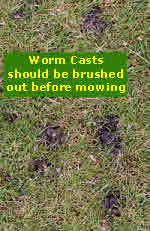
Before mowing a fine lawn, do check for worm casts. These small mounds of earth will allow weed seeds to germinate. You can use a stiff brush to disperse them.Lining Up The Mower And
Making A Stripe Pattern
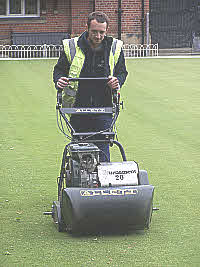
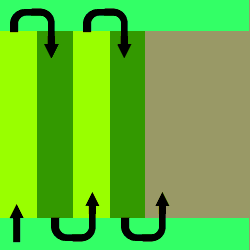
When mowing rectangular greens a cut along the longest edge helps you to line up all subsequent cutting strips for you. And this guide is even more useful where the lawn follows a long curved path. The featureless nature of a large lawn is bewildering without some form of guideline and this job requires concentration. Lawn mowers with powered travel take your weight off the handles so you can focus on track.
So start by mowing across at one end, then do the long edge. Cross cuts at each end provide a turning area or baulk to save you walking on flower beds. And as turning the lawn mower often requires a slight lift at the front end, a cross cut at that point is essential. Note that ride-on mowers turn completely on the spot.
|
>>>> |
|
Do take care to line up each strip carefully before you begin. Allow a small overlap on the already cut side.
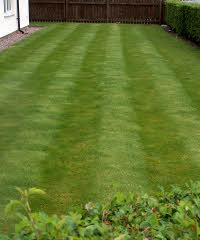
Lawn mowers with rear rollers add a nap to the grass blades. Strips are lighter when viewed along the direction of cut. So the light green dark green stripes change their shade depending on the direction from which you view them. A raised cutting height intensifies the stripe effect.
Cross Mow Fine Lawns And Greens
The finest greens for golf putting, bowls, croquet, tennis, and the like are given an additional cross mow. The second cut can be done with the grass box off. Otherwise this may result in a check pattern.But its purpose is to make a finer cut and grow an even surface. If you don't cross mow a fine lawn then any unevenness can be accentuated. So you should at least mow your strips at right angles to those of the previous grass mowing session.
Time And Motion And Efficiency
Emptying the grass box is undoubtedly the most tedious part of mowing. You can save time by placing bags at strategic points to collect grass cuttings. Note that some wheel barrows come with extensions to increase their capacity. Lawn mowers that have a large grass box are a distinct advantage when mowing extensive areas.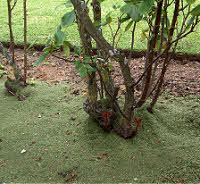
Another time saver is to put the grass trimming directly onto to earth around nearby shrubs and hedges. They conserve soil moisture and recycle nutrients to your plants. Only don't lay them thickly on shallow rooting plants like Azaleas.
After mowing your lawn, do lawn edging. Also, weed the immediate flower border. Then it's easy to pick up all the debris together.
Lawn Edging And Weeding Borders
Mowing doesn't cut the grass growing out at the edges or neaten the edge. There are 3 tools for edging:-- Power lawn edgers: do the job in one go; NOTE:- the most advanced tools combine edging, strimming and pole trimming hedges all in one tool.
- Edging shears:- simply cut grass that protrudes sideways along raised lawn edges. When this job is done weekly the trimmings can be left to lie.
- Half Moon edging spade: neatens and re-aligns the edge at the start and end of the season and perhaps also to get the best look in mid-summer.
The Tools For Keeping Your Lawn - click >>
-
Organic Moss Clearer & Lawn Fertiliser - kills moss, digests the thatch, and fertilizers your lawn.
-
A wide selection from Powered Mowers to low-cost Reel Mowers - rotary, cylinder, hover, and light compact machines, can all be found
on these links.
-
Riding Mowers are here to put you in control of a big job.
-
Innovative Lawn Aerators to make lawn care easy are here.
Scarifers
Edgers and
Edging Shears are on these links.
- You can be careless about cutting the grass with the Robotic Mowers available on this link.

-
Organic Moss Clearer & Lawn Fertiliser - kills moss, digests the thatch, and fertilizers your lawn.
All selected for their quality and performance.
- Mowers
- Scarifiers and Powered Rakes
- Hollow Tined Aerators
- Rollers
- Highly manoeuvrable Ride-On Machines for lawn mowing here.

Find more information on the-organic-gardener.com
|
Compare Lawn Styles |
Suitable Lawn Mowers |
New Lawns & Repairs |
Practical Lawn Mowing |
Maintenance For Better Lawns |
Lawn Weeds |
Lawn Fertilizer |
My Neighbour's Lawns
- Videos on lawn care to see the job in action,
- has the latest news on grass, Grass Clippings ,
- Top class detailed lawn care advice.
ALSO on the-organic-gardener.com
-
Do you run a gardening website - with information to interest my visitors? To set up exchange links from/to suitable pages - click here.

Custom Search
- The Home Of The Organic Gardener - growing naturally, pure and beautiful.
^ Top of the Greens & Pitches

Copyright © The Organic Gardener.Com 2004 - 2020.

[?] Subscribe To This Site


- Organic Garden Blog
- Grow More Flowers
- Grow From Seeds
- Grow Better Lawns
- Grow Potatoes
- Organic Fertilizer
- Weed Control
- Garden Tool Shed
- Garden Power Tools
- Garden Shredders
- Grow With Compost
- Gardening Gifts
- Gardening Books
- Crop Rotation
- Organic Pest Control
- Runner Beans
- Mulch It
- Garden Watering
- Moving Shrubs
- About Organic
- About the Gardener
- Organic Links
- Contact the Gardener
- Privacy Policy
