
A Compost Container to
make Home Composting Easy
You've probably seen the ready-made compost containers available for small to
medium sized gardens. Their good design owes much to moulded recycled
plastics. They work by a steady thru-put of regular small-scale
additions of organic matter.
& SOIL PROPERTIES
Your Kitchen Waste
Small Scale Continuous
Compost Making
The time and expense to build a small heap with timber construction
hardly seems worth it. That's why the (re-cycled) plastic compost
container is an exciting development. They solve the problem of low
input, save space and still produce the goods. With
smaller gardens that's ideal.
-
COMPOST CONTAINER CHECK LIST
-
Start by filling bin to the top,
-
Aim to keep it full,
-
Choose a larger size compost
container only if you can keep it full, the contents reduce quickly,
-
Easy to add relatively small amounts of organic matter. No need to store before composting,
-
Smaller 12 CuFt bins can be kept full with a small steady input,
-
Break, cut, or shred tough material before adding, especially the browns,
-
Shred and spreadthe shrinking heap to fill wall to wall and avoid large air spaces. Finer material helps retain heat and moisture, Check List continues after details of 5 recommended composters
Cone Bin or Compost Converter
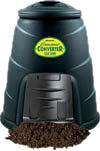
Without a doubt this is perhaps the simplest and one of the best small compost bins. Two sizes available.
The narrower upper section with tight lid recycles moisture internally. The material quickly reduces in volume so it won't be full for long. As it shrinks spread it out to ensure it fills the wider cross-section lower down.
The one-piece compost container is easily lifted off the heap whole to move to a new location. You can easily turn the heap by repositioning the container beside the heap and spading the material back into it again.
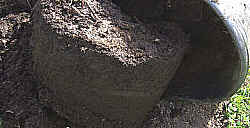
Mine provides moist black stuff thick with worms and a faint earthy smell - LOVELY the picture above doesn't do it justice.
The Cone Bin stands 40" (1 m) high, 32" diameter and holds 12cuft.
Quick way to dispose compost
there's more inside
 U.K. Gardeners can find the Compost Converter and a good website for compost containers along with other composting accessories all on the above link
<< or click this image.
Note: an additional Converter Base Plate is available for mounting on solid surfaces or to prevent vermin entry. The removable bottom door provides easy access to finished compost.
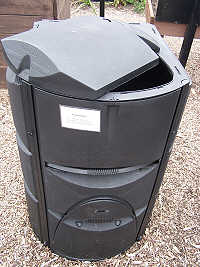
I saw this one displayed at the Garden Organic in Ryton, Coventry. Its design takes full advantage of moulded plastic.
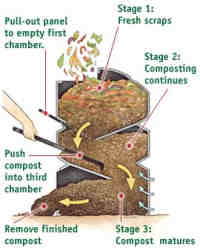
A removable upper shelf retains material for an initial stage of rapid hot composting. Slide the shelf back to let the material down the middle section where composting continues.
Finally use a rod to push the composted material down to the bottom to mature.
The system has advantages. Material at the same stage of decomposition gets hotter than when mixed with older material. The system more or less prevents unfinished compost from mixing with completed compost.
It also gives the worms a clear run in the cooler lower section of the container.
The Earth Maker Aerobic Composter is available in America -
more details on this link
In the U.K. you can find the Earth Maker Aerobic Composter on this link.
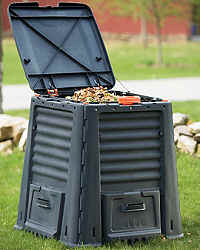
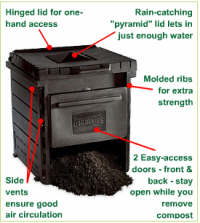
The Easy Open Composter
Another 'down to earth' composter. This one simply snaps together. If you have arthritic fingers then you'll find the push button opening lid
an improvement on the compost converter. Also the doors can be used as leaf collecting scoops.
Same rules apply - keep it full and the material spread wall to wall. Several doors provide plenty of access to the finished compost.
At 30" square and 34" high this bin can hold 16 cubic feet of material.
The Pyramid Bin
A popular compost bin. This has a wider opening and added organic matter will be more
spread out. Periodically turn the outside of the heap to the inside and vice versa using a fork or aerator. It has an open base
and an additional rodent screen can be obtained to thwart burrowing animals.


Quick way to dispose compost
there's more inside
28" square 34" high. Comes as a flat
pack with self assembly to make a bin advertised to contain 12 cu ft,
but I make that 15CuFt.
Find more details about these and other composters on this link.
Aerating Tools
2 things are important when aerating your heap - to break apart dense clumps, and to move the material that has been on the cooler outside to the hot centre.Aerating tools have been designed specially for
stirring up the heap. They do save you somewhat from getting your hands dirty. U.S.A. gardeners have a "deluxe version" - a 2
handled aerator with 2 sets of folding stirrer wings
and in the U.K. composting accessories include a simple aerator.
^
Top
of page
COMPOST CONTAINER CHECK LIST CONTINUED
- Aerate periodically. An aerating tool cuts and break lumps apart; or thrust a garden fork into the heap and lever it around,
- Smaller volumes in these compost containers gives less prolonged or intense heat so keep adding new material and aerate periodically,
- Formulated compost activators contain specific bacteria and nutrients for hot composting but are not essential,
- Aim to mix green and brown matter equally - optionally, use nitrogen supplements:- comfrey, poultry manure, urine, dried blood,
- Scatter a thin layer of finished compost over every 6 inches or so of new material. Suitable micro-organisms will grow throughout the heap,
- Heat generated raises the temperature in the upper middle section of the bin - a narrower top section helps reduce heat loss,
- Tight lid and plastic walls keep fresh material moist, conserve water vapour inside, and reduce losses by leaching. No messing with plastic sheets on windy days,
- Pre-soak organic matter if it's really dry but avoid direct watering inside the compost container,
- Open base allows small animals e.g. worms, to digest the cool end. The finished stuff is moist, black, crumbly,
- Often quoted completion times 4 to 6 weeks for ideal conditions e.g. shredded material, warmth, ideal moisture content, using activator etc...
- After decomposition, another 3 months to meld should be given, perhaps in a seperate bin,
- Compost container can be set up almost anywhere and easily moved to a new location,
- Plastic is very durable. No maintenance needed.
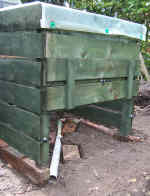
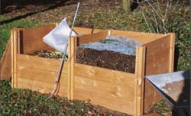
Click to read: About the Larger Compost Containers of Traditional Timber...
|
|
|
Find more links about Compost Gardening below:
|
Types Of Garden
Composter |
Help On Making & Using Organic Matter |
How To Recycle
Waist With Worms |
|
|
> Static Fast Through Converters > > Traditional Large Heap Containers > |
> Decomposition In Progress - Hot & Cold > > Recycling Organic Matter In Many Ways |
> Mix Your Own for Seeds, Potting, Planting... > Horticultural & Proprietary Mixes > Make Best Use Of Organic Matter |
> > |
My Neighbour's Compost Heaps
- Avant Gardening - use sustainable organic gardening for creative expression & spiritual growth - find workshops, monthly newsletter, virtual tours, ...
- Home Herb Gardening - get healthy with herbs & learn how 'small' means sustainable with herb gardening & business
- Gardening Guides - Hundreds of articles about flower, vegetable & fruit gardening, garden design with tips & tricks
Do you run a gardening website - with information to interest my visitors? To set up exchange links from/to suitable pages - click here.

- The Home Of The Organic Gardener - growing naturally, pure and beautiful.
^Fill your compost container from the top




- Organic Garden Blog
- Grow More Flowers
- Grow From Seeds
- Grow Better Lawns
- Grow Potatoes
- Organic Fertilizer
- Weed Control
- Garden Tool Shed
- Garden Power Tools
- Garden Shredders
- Grow With Compost
- Gardening Gifts
- Gardening Books
- Crop Rotation
- Organic Pest Control
- Runner Beans
- Mulch It
- Garden Watering
- Moving Shrubs
- About Organic
- About the Gardener
- Organic Links
- Contact the Gardener
- Privacy Policy
