
What Makes Your Garden Spade Do More Work?
* Design features of a modern garden spade,
You should also be aware that there is a wide range of quality, from throw away tools to the solid forged strength and durability. Below, you'll find links to some good solid tools. Send me your feedback and comments with this link. First, let's check out the main design features to look for in a quality garden spade.
The Essential Garden Spade and ShovelHANDLES Comfortable D shaped handles enable a powerful all-around grip. Some have a collar and rivet fixing and are of 'man-made' materials with a non-slip velvety soft feel. These handles are usually inclined to reduce reach and give more leverage for border spades. 'Radius' garden Spades are fitted with O handles - consider them if you dig on tough ground with both hands on.Alternatively hardwood shafts are spliced into a 'wish-bone' to make varnished handles that look really good but have a harder and colder feel. These straight D handles make chopping easy and give better balance to larger heavier spades. Traditional T shaped handles with tongue and groove and wood sprig or rivet fixture are very much back in fashion. But they lack some of the durability, versatility and control of D handles. To preserve these handles properly and prevent shrinkage and loosening it is essential to treat them with Linseed Oil see below. STRONG AND LIGHT Wood is organic and needs proper care. U.K. gardeners click here for garden tool maintenance kit - includes linseed oil to condition wood, blade sharpening stone, cloth and keep-clean containers.Hardwood offers down-to-earth good looks, and some tools are given heritage antique finishing. Ash wood gives the highest strength to weight ratio and is highly resistant to shocks. But the structure and machining of wood limit the design and shape. Moving on, synthetic materials such as polypropylene have brought moulded ergonomic designs. Fiberglass and Nyglass make particularly strong light-weight shafts. But read the section on joins below. 
SPADE OR SHOVEL STYLE English spades have squared off blades that steady your digging stance. They're ideal for digging neat square trenches.Alternatively, the pointed American shovel blade concentrates down force and works better in stony ground. Irish Spade blades have more curvature on the face to focus greater force on the soil volume in front. Combine this with a longer narrower blade and longer shaft and you get the leverage and reach you need for deeper digging. There's more specialised spades here. JOINS Shovels commonly use open back joins. These are weak but easy to replace.Spade shafts are driven into round sockets and fixed with a rivet. Alternatively, the shaft is fixed front and back to 2 metal flanges known as strapping. Extra long strapping with 3 rivets makes the strongest join, and used on Irish spades that have longer blades and shafts. ON YOUR METAL WITH SOLID FORGED BLADES Polished stainless steel gleams smartly, is easy to clean, and resists corrosion. But when made into garden forks it may be vulnerable to metal fatigue (i.e. crack after repeated bending).Carbon steel is more durable and lighter, but not as rust resistant and less likely to make a strong weld. But to get a garden spade that lasts - go for a carbon steel blade and socket solid forged as one. Boron steel is another alloy with greater internal hardness. Every garden tool is made for a purpose. Do remember that spades are simply not intended for jobs like hammering posts into the ground... When underground rocks snag a spade of fork tine do resist the temptation to apply brute force. If you've broken a garden fork consider the Spork instead.
PROTECTIVE FINISHES Protective epoxy powder coats are applied to steel by spraying highly charged epoxy/metal powder at the electrically grounded tool, followed by baking. Teflon and enamel/gloss coatings may also be used. Coatings wear off during use. Alternatively carbon steel may be burnished and stainless steel polished. Antique finishes are popular.More spades below...
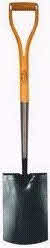
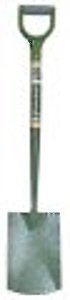
Buy Solid Garden Spades -
|



 +
+


