

Flowers For Your Home & Sweetheart
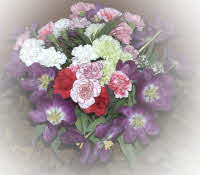
* Vases, posies, wreaths, bouquets & button-holes,
And you don't have to worry about packaging. Because when you buy these floral arrangements to send to a friend you can be sure of getting something extra special.
Home-grown FlowersBut this page is about how you prepare and present your home-grown floral decorations - from bouquets and posies, to vases and wreaths... ... Or indeed how you prepare a vase and make your blooms last longer - see below.Note that some of the American flowers bought from this link actually come in small vases of water to keep them fresh. But you'll find attractive vases and bowls to display your arrangement, on the links below. Choose Your Vase CarefullyBeautiful blooms need a handsome vase. Indeed your vase is an integral part of your floral arrangement. So first:-
Flowers and Vases for your home are here.
If you live in the UK - check out this amazing self-moulding vase - you can remould them when warm - they set solid when cold.
Make Your Floral Arrangements Last Longer
Professional information to help you care for cut blooms is on this link and outlined below.
Foils & Greenery For Your ArrangementGreenery from conifers, holly, ferns and palms, as well as small misty looking inflorescence like Gypsophila make an ideal background for the main display of bold bright coloured blooms.Making WreathsYou need some wire, such as a coat hanger, bent into a circle to form the frame. Small wire ties are used for twisting around stems and with greenery to hold it into place. Ribbon and glitter may also be useful. Florist's accessories - including wreath rings, sponge, scissors, ties... can be found from these links.OasisFlorists use a sponge known as Oasis. The makers claim that Oasis Maxilife meets or beats the life of flowers in a vase of water. Stalks are inserted into Oasis which can be easily cut and placed into the bottom of a vase or dish.Dried Flower ArrangementsAlthough dried floral arrangments lack the vivacious immediacy and romance of living blooms they do last much longer.However, their main advantage is surely the unique shape and architecture they bring to your decor. Indeed, dried seed heads, cones and grasses, twigs, logs and bark cannot be missed by those who enjoy an earthy natural style for rooms and furnishing.
Buy Bouquets, Hand-Ties, Beautiful Arrangements,
|



 |
- You can find flowers sent in water on this link.
-
Florist's accessories - scissors, foil, foam, wreath rings and ties... are here
-
You can find a nice selection of vases on this link or click below.
-
DirectGardening.com - Offers quality plants at great prices, click to see what I mean!


|
|
- Try Bunches.co.uk - they support the ethical voluntary code Florverde, set up by the Colombian Flower Growers Trade Association.
-
Florist's accessories - scissors, foil, foam, wreath rings and ties... are here
-
You can find a nice selection of vases on this link or click below.
- Start here to grow your own blooms for cutting.

Find more information on the-organic-gardener.com:
- Learn about patio and container gardening,
- Discover the hidden delights of an organic garden and,
- Get tips on how to grow your own blooming plants from seed,
- where to buy plants and how to care for plants when they arrive.
My Neighbour's Flower Gardens
-
Do you run a gardening website
- with information to interest my visitors?
To set up exchange links from/to
suitable pages - click here.

^Top with Blooms

